
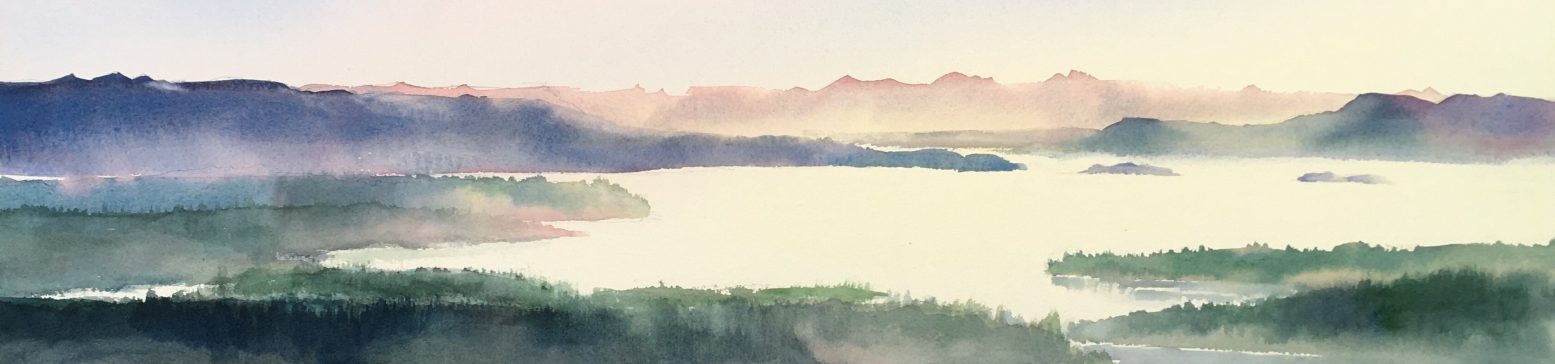

Names matter. They mark our particularity, situate us in history, and can even be part of telling our story. Ann’s full name – Ann Cory Dodgson Dorsey – divides nicely into four parts. For my storytelling, Ann Dodgson refers to the first nineteen years of Mom’s life. In 1966, she married Dad. I tell the story of those years by her taken name, Ann Dorsey. I trace her artistic journey under her art name, Ann Cory. Finally, in her full name, Ann Cory Dodgson Dorsey, I see the blossoming of her mature beauty, like a late summer day in the garden she loves so well.

How Ann Got Her Name
“Don’t name her Fanny,” Fanny warned her pregnant daughter Sayre, whapping her behind with her hand for emphasis. Ann was in her 50’s when she realized that Sayre had, after all, named her after her beloved grandmother Fanny in her first and middle name. Ann Cory Dodgson was born the evening of May 23, 1946, after Sayre tucked her older sister, Margaret Sayre , and brothers Thomas Galen and Robert George to bed. Then Sayre make her way to the hospital in Moroni, Utah, where her husband Thomas “Doc” Dodgson delivered their daughter. Let’s begin Ann’s story with her beloved Grandmother, Fanny Y. Cory.

Fanny Y. Cory Cooney
Born in 1877 in Waukegan, IL, of Scottish immigrant stock, Fanny had a precocious imagination and prodigious talent, but also disadvantages: poverty, the death of her mother Jessie from consumption when she was ten, and a possessive and absent father who drank too much. At age twelve, Fanny and her older sister Agnes, who had contracted tuberculosis caring for their mother, moved to Helena, MT. Fanny lived with their brother Bob who was carving out a life there, Agnes with friends of the family.
Fanny dropped out of school in the eighth grade. Before she quit, the art teacher, Mary C. Wheeler, who had studied at The New England Conservatory’s Department of Fine Arts and at the Julienne Academy in Paris, noticed Fanny’s true talent and encouraged her to stick with art. Fanny’s break came when she got a letter from her brother Jack, a well-known newspaper illustrator, cartoonist and caricaturist for Pulitzer’s The New York World. It held one hundred dollars and a note inviting her to live with him and his wife Bertha in Manhattan and enroll in the Metropolitan School of Art.

It was the spring of 1885 when Fanny arrived in New York City. Though only seventeen, she quickly rose as to the top of the class. She was accepted into the prestigious Art Students League where many of America’s finest artists were instructors. After a year, Jack’s ability to pay her tuition ran out. Fanny left art school, “…to make my fortune,” she said and did. By the time she was nineteen, she made enough to keep a home for herself, her sister and father. By 1900, F.Y. Cory illustrations graced Scribner’s, Century, Harper’s Bazaar, Life, The Saturday Evening Post, McClure’s, Liberty, Youth’s Companion, St. Nicholas, and the Ladies Home Journal. As an up-and-coming illustrator, Fanny was invited to parties, like when the literary giant Mary Mapes Dodge invited her to her country estate in the Catskill Mountains. Fanny turned them down. Years later she explained why.
“Soon I met Mary Mapes Dodge, the owner of St. Nicholas and chief editor. She was a lovely woman. She asked me to come to a lovely party she was giving for other young artists at her home in the country which I’ve no doubt was a beautiful place. And I couldn’t accept it. You see, at that time my sister was living, and I had to leave her alone so much that I didn’t like to do anything that was unnecessary. She was always watching for me in the window when I came home. I didn’t want her to watch in vain.”
Fanny had been warned that Agnes might die at any time of a pulmonary hemorrhage. When it happened in 1900 it devasted her. She didn’t speak of Agnes’ death until one summer evening decades later at the Dodgson farm on Camano. Fanny, her daughter Sayre and granddaughter Margaret were snapping pees. Then in the fading sunlight, she told them all: how she woke to hear Agnes’ fingers tapping the coverlet. “I jumped up, struck a match to light the gas, saw my own scared face in the glass and wondered ‘Is this it?’ and turned to find my darling vomiting blood in great globs, her frightened eyes on me. I held her in my arms, praying to God, I think. It was not long – the frightened look was gone, the eyes grew dim and I knew she was gone.”
Fanny sank into depression. Work didn’t lift her. Nor did the trip her best friend took her on to her family’s home in Texas. Her depression was so severe that her brothers Bob and Jack planned a summer trip in Montana for her. Camping and fishing outdoors renewed her spirit. She went back to Manhattan and her work. But Montana’s mountains had staked a claim in her heart. In 1902 she returned to Montana for good. She lived in a small cabin along Beaver Creek next to two the cabins where Jack and Bob ran “The Cory Brothers Mine.” Fanny threw herself into the operation as its main financial backer, raising money through her illustrations. They didn’t strike it rich.
When Fanny had left New York, William Fayal Clarke the editor of St. Nicholas, gave her a copy of The Virginian inscribed with note wishing that she might meet her “Virginian.” She did. He turned out to be a Montana rancher hewn from Irish pioneer stock. Fanny married Fred Cooney in April 1904. They made their home in a humble house a stones-throw from Lake Sewell on the Missouri River near Canyon Ferry. Fred ran the 1,800 acre ranch. Fanny illustrated books and magazines. After her firstborn, a boy, died during delivery and a year of debilitation from that trauma, three darling children came: Agnes who went by her middle name Sayre, Bob and Ted. Fanny laid down her art career and threw herself into mothering. Ann’s roots of mothering would come from Sayre through Fanny, who Sayre, Bob and Ted called Meetsy, a shortening of the nickname Sweat Meats.

Sunnyshore Studio Invites you to an 80th Birthday Celebration and Show of a lifetime of Ann’s art, seeing over her shoulder and through her heart at her long lived loves. The show takes place on the day of Ann’s Birthday, Saturday, May 23rd, 10am-4pm at Sunnyshore Studio: 2803 SE Camano Drive, Camano Island
